Vaccines · India and the United States · 2020
GSK: five minutes to answer, so I ran a survey first
SECTOR
Vaccines
MARKET
India and the United States
COMPANY
GSKROLE APPLIED FOR
Senior Innovation Specialist
DATE
January 2020
Stages covered
01
Research
02
Competition
03
Segment & position
04
Message
05
Launch & enable
06
Measure & maintain
The same six stages as the PMM Operating System.
The situation
Adult vaccination coverage in India was, at the time, close to negligible.
Childhood immunisation had improved enormously over two decades. The same person at fifty-four had usually never been offered anything, and often believed vaccines were a children's product.
I was given two problems and ten minutes of airtime to answer both — five minutes each, inside a forty-minute panel. Five minutes is not enough time to have an opinion worth hearing. It is enough time to present something you did beforehand. So one problem got primary research and a working prototype, and the other got an argument against the idea I had been handed.
68
People surveyed
9
Indian states
1
Vaccinated in the last year
What I brought into the room.
The decision
The stated problem was hesitancy. The data said nobody was being asked.
The brief was explicit about why adult vaccination rates are low: low awareness of adult vaccines, and a hesitant attitude built on the belief that vaccines are for children. Both are real, and both showed up in the survey.
But the number that reframed the problem was a different one. Twenty per cent had received a recommendation from their own healthcare provider. Four in five people had never been asked. Hesitancy is a persuasion problem and you solve it with a campaign. Not being asked is a workflow problem, and you solve it inside the provider's system — recommendation prompts, recall, standing orders, and a financial reason for the hospital network to run them.
Which is why the answer was an app plus a set of things that are not an app, and why the customer journey marked the points only the hospital networks could fix.
The work
Five moves, ten minutes of airtime.
01
01 Research
A survey, because five minutes of opinion is worth nothing
- Ran a customer survey ahead of the interview: 68 respondents aged 50 to 60, across 9 Indian states
- Awareness of adult vaccination: 30%
- Had received a vaccine recommendation from their own healthcare provider: 20%
- Vaccinated in the last year: one respondent
- Which moved the answer from an opinion about hesitancy to a measurement of a gap
02
02 Competition
Map what already exists
- Positioned the available options on two axes: active or passive, simple or complicated
- Everything on the market was either a silent record or a portal you had to navigate
- Nothing reminded anyone of anything, which is the specific failure for a vaccine you need every year or every decade
What was already available
Active — it comes to you
Passive — it waits for you
Active — it comes to you
MyVAC
What I proposed: a record, reminders and appointments in one place
Provider portals with recall
Active, if you can navigate them
Passive — it waits for you
Paper records and information websites
Accurate, and completely silent
Hospital apps
A record you have to go and find
Simple
Complicated
Everything available was either silent or hard. Nothing asked you to come in.
03
03 Segment & position
One person, named, from the survey
- A persona built from the responses rather than from a workshop: Jayasudha Kapoor, 54, Bengaluru, running a business from home
- Needs, in her order: awareness, access, reminders, cost, risk
- Used as the single thread through both the current journey and the proposed one, so the panel could follow one person rather than a segment
04
04 Message
The journey, before and after
- Five stages: needs and expectations, awareness, consideration and decision, adoption, advocacy
- Populated with what respondents actually said rather than with stage labels
- Then redrawn with the proposed solution in place — and, answering the brief's second question directly, marked the points that only the hospital-network brainstorm could resolve rather than pretending an app fixed them
- Including one new concern the second version introduced, because a solution that creates a worry should say so
The same five stages, redrawn
Needs & expectations
Awareness, reminders
Before
I thought vaccines are for children
With MyVAC and the hospital network
I saw a campaign about adult vaccination
Awareness
To be told it applies to me
Before
My doctor never recommended vaccines
With MyVAC and the hospital network
My doctor recommended vaccines
Consideration & decision
Accessibility, timings
Before
I live far from a hospital or a pharmacy with stock
With MyVAC and the hospital network
I see a list of providers and can book online or at home
Adoption
Little or no wait time
Before
I'm worried about the cost
With MyVAC and the hospital network
I know what it costs before I go
Advocacy
No side effects
Before
I'm worried about side effects and other risks
With MyVAC and the hospital network
I know the aftercare and can plan around it
The second version also introduced a new worry — the privacy of a health record held online — and I left it on the slide.
05
05 Launch & enable
A prototype, not a concept
- MyVAC: vaccination history pulled from a provider or entered manually, a record of which vaccines you have and haven't had, reminders, and appointments
- Designed and prototyped as screens rather than described in bullets, because five minutes of slides beats five minutes of description
- Around it, the non-digital half the brief also asked for: broadcast and social awareness campaigns, educating providers, priority online appointments, standing-order programmes and home visits
- And the uncomfortable part: auditing physician vaccination rates and giving hospital networks a financial reason to recommend and deliver, through screening programmes and lab tests
MyVAC, prototyped
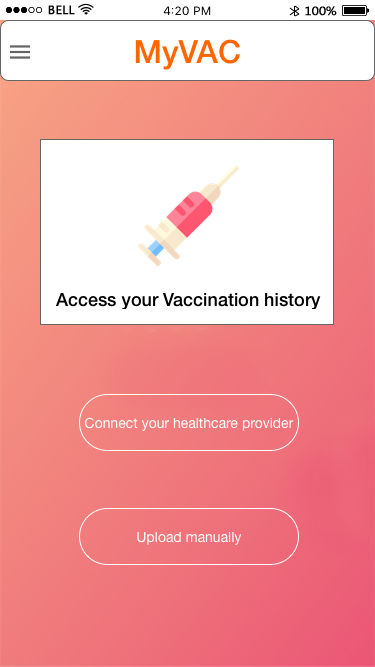
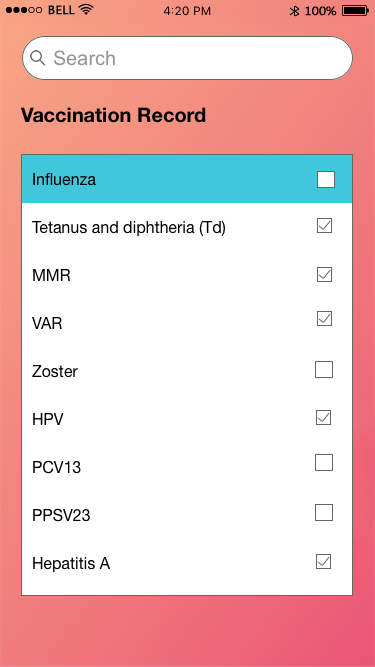
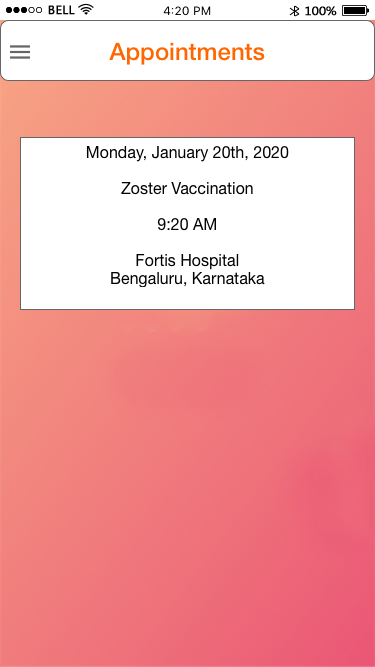
The original 2020 prototype screens, with one phone number removed. Five minutes of slides beats five minutes of description.
06
02 Competition · 06 Measure & maintain
Assess the winner rather than approve it
- Named what was genuinely good: social listening does find the moment, does surface pain points, and does let a strategy adapt on live feedback
- Then the reach problem, with numbers: around 40% of US adolescents did not go to college (2017), around 30% did not use social media (2018), and 6% preferred Twitter (2019) — with the dominant adolescent platform changing roughly every two years
- Then the targeting problem: adolescents are the end user, not the decision maker. Parents are. And a university admissions office is a more constant gatekeeper than a platform that turns over every two years
- Then the two that stop a project rather than slow it: HIPAA, and the ethics of social listening on minors and messaging them directly
- Then gave them the roadmap anyway, with success factors — goal, timeframe, KPIs, meningitis rates among adolescents, GSK's social licence, ROI, and community and hospital relations
Where I pushed back
They asked me to assess the hackathon winner. I said it would miss most of the population.
The idea had already won. The easy five minutes is three pros, one soft con and an implementation plan.
Instead I put numbers against its reach — adolescents who don't go to college, adolescents who aren't on social media, and Twitter's actual share of teenage attention — and pointed out that it messaged the wrong person, because in adolescent vaccination the decision maker is usually a parent and the durable gatekeeper is a university rather than a platform with a two-year half-life. Then HIPAA, and the ethics of listening to minors and direct-messaging them about their health.
I still gave them the implementation roadmap and the success measures. Saying no without a plan is just criticism.
What I'd change
Sixty-eight self-selected respondents is a signal, not a study, and I presented the percentages more confidently than that sample supports. I'd show the same findings today as directional and say plainly what it would take to confirm them. The finding was strong enough that it didn't need the extra confidence.
What happened next
The segment was real, and the platform risk was real.
Jan 2020
I presented this. Adult vaccination in India was a segment with negligible coverage.
Apr 2023
GSK launched Shingrix in India, a vaccine for the prevention of shingles and post-herpetic neuralgia in adults aged 50 and above — the exact population in challenge one. GSK India
Since
Twitter's standing with adolescents did not hold, which was the specific fragility named in challenge two.
I'm claiming no connection between my forty minutes and a product launch three years later. What the launch shows is that the segment in challenge one was real and worth building for, which was the thing the survey was arguing.
The part I'd defend hardest is that survey. Sixty-eight responses is not a research programme. But it took the answer from a plausible story about hesitancy to a measurement showing four in five people had never been asked by their own doctor — and that changes what you build, from a campaign into a workflow.
The brief, as it was set
Brief set by GSK
January 2020
Two challenges, five minutes each, in a forty-minute panel
Challenge 1
Adult vaccination rates are low in the adult population 50 to 60 years old. There are some insights on why: low awareness of vaccines in adulthood or of the diseases, and secondly a hesitant attitude towards vaccines in adult life, a general belief that vaccines are for children. Brainstorming sessions are planned with hospital networks. Considering the target audience, are there any digital or non-digital solutions you would consider on how to tackle low vaccination coverage in this segment? What aspects of the adult customer journey would you consider relevant to understand ahead of the brainstorming sessions with hospital networks?
Challenge 2
Following a hackathon with participants from diverse backgrounds, an idea to tackle low vaccination rates against meningitis in the adolescent population in the United States was selected as a winner. It has two components: social listening to identify conversations around meningitis, or relevant conversations over starting college, as starting college is normally where an adolescent would get vaccinated against meningitis; and connecting via Twitter with those identified conversations to provide information around disease and prevention. With the information at hand what are the pros and cons of this digital solution, what other information would you need to finalise your assessment of its viability considering transparency, privacy and likelihood to succeed? Describe the steps you would take to implement this experiment in a country, and how would you assess the success of this project?
Quoted from the brief pack. Challenge 1 was set for India, challenge 2 for the United States.
What I wasn't given
5 min
Per answer
2
Countries
1
Idea I was expected to endorse
Not givenNo market data was provided. So I went and collected some.
Set by the company as part of a senior hiring process. Unpaid, and answered from outside — no access to their customers, their data or their team.